
 6 / 20
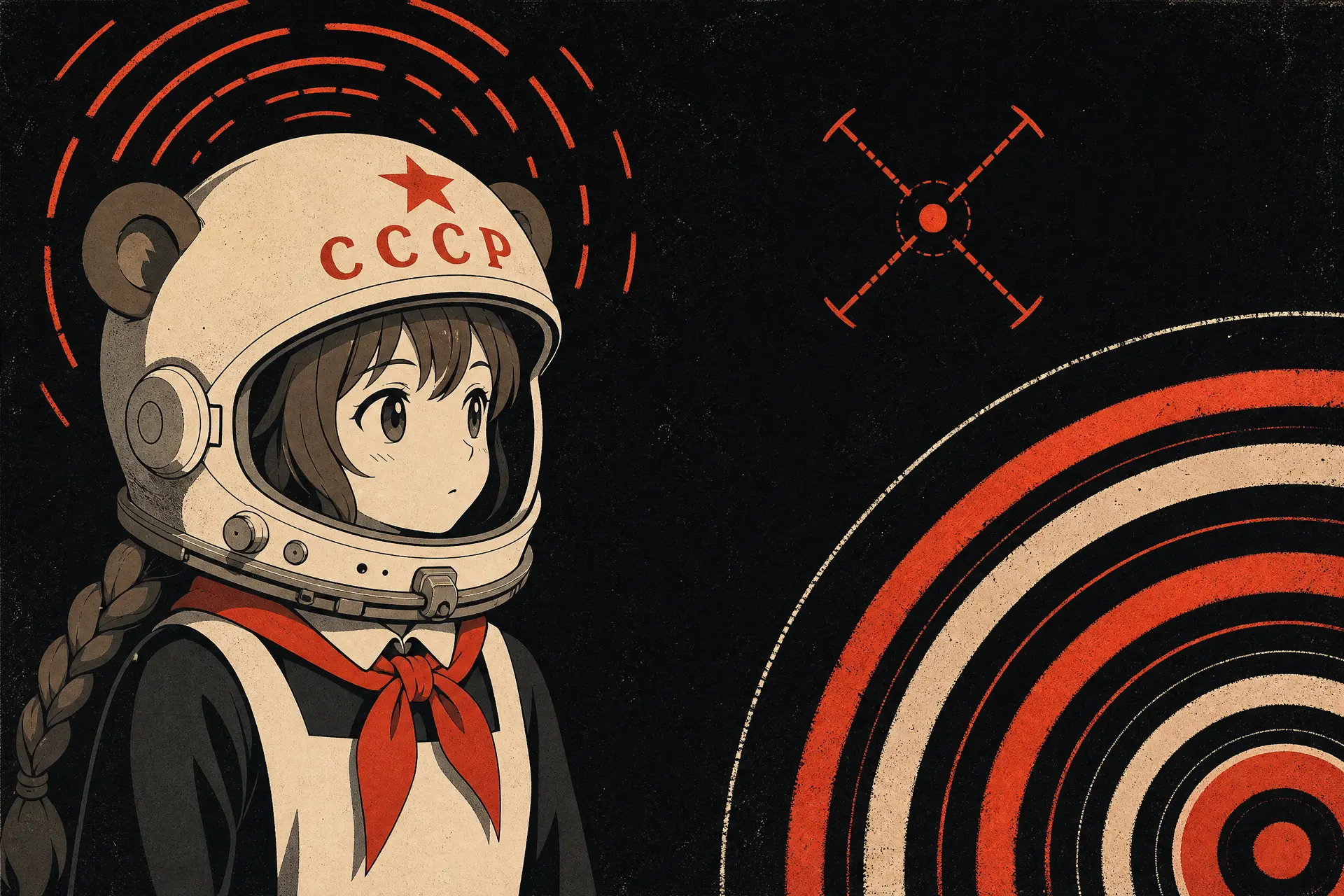
Horizontal illustration, retro mimeograph printing and minimalist flat vector…
Prompt
Horizontal illustration, retro mimeograph printing and minimalist flat vector style, full color, limited to a high-contrast palette of black, off-white, dark gray, and orange-red. This is an illustration of the space race era, radio fantasy, and a young girl wearing an astronaut helmet from Figure 1—silently transmitting and receiving between abstract geometric signals and the deep black cosmos. With Figure 1 as the protagonist, an asymmetrical left-right bipartite composition The image is clearly divided into two fields, left and right. The left side occupies about two-fifths of the frame, featuring a concrete half-length portrait of the girl, her form built from overlapping black and dark gray color blocks without contour lines, shaped solely by the boundaries of the color blocks. The right side occupies three-fifths, a vast expanse of deep black—not empty, but bearing a large abstract geometric figure that serves both as a cosmic background and a display screen for signals. The visual weight of both sides is balanced through precise area ratios: the “solid” on the left and the “void” on the right confront each other in silence. Left-side figure: Bear-eared girl wearing an astronaut helmet She faces right, her body in a half-profile pose, her gaze level, looking toward the deep black geometric field on the right side of the image. On her head, she wears a bulky Soviet-style astronaut helmet, painted flatly in off-white and light gray, with a highly prominent red star emblem on top and the Cyrillic letters “CCCP” printed on the front in bold, slightly worn-edged typeface. A pair of round bear ears naturally protrudes from both sides of the helmet, their soft curves contrasting with the helmet's hard sphere. She wears a black dress inside, a white apron over it, and a red scarf tied at the collar—a Soviet-style plain school uniform, creating a clear disjunction with the astronaut helmet symbolizing distance and technology. This state of “only wearing the helmet, not yet changed out of the school uniform” preserves her childish innocence and her most naive yearning for spaceflight. Her face is rendered as a flat off-white color block, with facial features outlined only in dark gray fine lines—a pair of round, quiet eyes, a small nose, lips slightly closed, an expression focused and slightly curious, without exaggerated emotion, more as if she is listening to something. Signal emission from the top of the head From the top of her helmet, several orange-red concentric arcs and short line segments radiate upward and outward, mimicking the abstract form of radio signals or Wi-Fi waves. These arcs have no gradients, all painted in solid colors, with deliberately retained rough jagged edges on the borders, simulating the misregistration texture of screen printing. They emanate from her, spreading upward and into the right space, naturally guiding the viewer's gaze toward the right half of the image. Right-side field: Radar and cosmic echoes In the lower right corner of the image is a large concentric semicircular wave pattern in orange-red, off-white, and black, resembling the echoes on a radar screen or the cross-section of a spinning record. The concentric semicircles rise from the lower right edge of the image, spreading outward ring by ring, with uneven spacing between the waves—dense near the center, gradually sparse outward, producing a slow, rhythmic visual vibration. To the upper left of this set of concentric waves floats a smaller radial signal pattern—four orange-red line segments radiating from a single center in diagonal directions, each ending with a short perpendicular tick, like an abstracted North Star or a simplified symbol of a rotating radio telescope. There is no connecting line between these two geometric forms, but they form a clear visual correspondence—one transmitting, one receiving, or both silently waiting for a response from farther away. The large expanse of deep black background envelops these shapes, making the orange-red and off-white appear particularly calm and powerful against the dark backdrop, like a faint but persistent signal source in deep space. Color system and mimeograph printing texture The entire image is strictly limited to four colors: black (cosmic background, dress, dark gray levels of shadows), off-white (helmet, apron, skin, some layers of the waves), dark gray (transitional color of clothing, midtones of geometric forms), and orange-red (red star, scarf, signal waves, radial symbols). No gradients, no highlights—all tonal transitions are directly cut by clean, sharp color block boundaries. The edges of the color blocks deliberately retain slight misalignments and irregularities—for example, at the junction of orange-red waves and the black background, extremely thin off-white gaps are left, mimicking the misregistration marks of old screen printing. Some color block surfaces have very slight dry brush effects and sparse dot patterns, as if the ink did not fully cover the paper, all reinforcing the hand-printed warmth of space race propaganda posters from the 1960s and 1970s. Overall atmosphere and emotional direction The image is quiet and restrained, without intense movement or dramatic narrative. She simply wears an adult's helmet and her own school uniform, facing the abstract waves and signals in a deep black cosmos. Whether those geometric patterns are echoes from the outside or questions emitted from her helmet need not be answered. The entire image lingers in this suspended moment—childhood and grandeur, school uniform and helmet, reception and transmission—all oppositions gently wrapped in flat color blocks, like an old poster smoothed by time, preserving an era's collective gaze at the starry sky in minimalist graphic language.